

Pricing is where strategy meets reality. It is also where many B2B SaaS companies quietly bleed margin.
Founders obsess over product features and growth loops, but pricing often gets set once and left alone. That is a mistake. In subscription software, pricing is not just a revenue lever. It shapes customer acquisition cost, lifetime value, churn, positioning, and even product roadmap.
Search interest in terms like “B2B SaaS pricing,” “SaaS pricing models,” and “how to price SaaS” reflects a simple truth: there is no default answer. But there are patterns, metrics, and common traps worth understanding.
The Four Core SaaS Pricing Models
Most B2B SaaS companies rely on one of four structures: seat-based, tiered, usage-based, or hybrid. Each model signals something different about value.
Seat-Based Pricing: Simple, Predictable, Expensive to Scale
Seat-based pricing charges per user per month. It became popular with collaboration tools and CRM systems because it is easy to understand and forecast.
Companies like Salesforce and Atlassian built large businesses on per-seat models. The appeal is obvious. If a customer grows from 10 to 50 users, revenue scales linearly.
But the downside is friction. Customers become protective of licenses. They share logins. They hesitate to add new users. In a product-led growth environment, that friction can cap expansion revenue.
Seat-based models also assume value is tied to headcount. That works for collaboration software. It breaks down for automation tools, infrastructure products, and analytics platforms where value correlates more with usage than with users.
Tiered Pricing: Anchoring Value Through Packaging
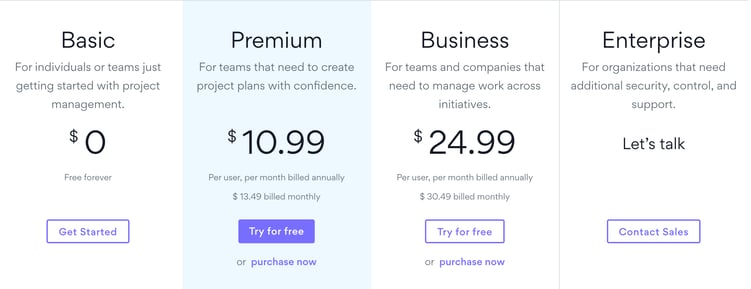
Tiered pricing bundles features into packages, typically labeled Basic, Pro, and Enterprise. It is less about cost and more about segmentation.
The goal is to create natural upgrade paths. A startup might start on a $49 per month plan and later move to $199 as usage grows or advanced features become necessary.
Tiered pricing works well when customers vary significantly in size or complexity. It allows a vendor to capture willingness to pay without negotiating every contract.
The risk is overcomplication. Too many tiers confuse buyers. Too many feature gates frustrate them. The most effective pricing pages often show three or four options, with one clearly positioned as the default.
Usage-Based Pricing: Aligning Cost With Value
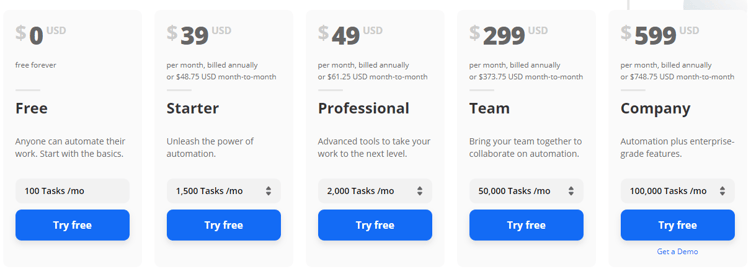
Usage-based pricing, sometimes called consumption pricing, charges based on measurable activity: API calls, transactions, gigabytes processed, or emails sent.

Infrastructure providers like Amazon Web Services normalized this model in cloud computing. More recently, developer tools and data platforms have adopted similar structures.
The advantage is alignment. Customers pay more when they get more value. Early-stage customers can start small without committing to high fixed costs.
The challenge is revenue predictability. Finance teams prefer stable monthly recurring revenue. Usage-based models can create volatility, especially if customer activity fluctuates seasonally.
They also require strong billing infrastructure. Metering must be accurate. Pricing must be transparent. A surprise invoice is one of the fastest ways to increase churn.
Hybrid Pricing: The New Default
Increasingly, B2B SaaS companies combine models. A base platform fee covers access, then usage or seats scale the bill.
This hybrid approach balances predictability with upside. A customer might pay $1,000 per month as a base subscription plus variable charges tied to volume.
Hybrid pricing works particularly well for mid-market and enterprise segments. It ensures minimum contract value while preserving expansion revenue as adoption deepens.
But complexity grows. Sales teams need clear messaging. Finance teams need robust forecasting models. Customers need clarity about what drives their bill.
The Metrics That Should Drive Pricing Decisions
Pricing does not exist in isolation. It should be grounded in unit economics.
CAC and Payback Period
Customer acquisition cost (CAC) measures how much it costs to acquire a paying customer. In B2B SaaS, CAC can range from a few hundred dollars in product-led startups to tens of thousands in enterprise sales models.
Investors typically look for CAC payback within 12 months for SMB-focused SaaS and up to 18 to 24 months for enterprise-heavy companies. If pricing is too low, payback stretches. Growth becomes capital-intensive.
If your average annual contract value is $12,000 and your blended CAC is $15,000, your payback period exceeds a year even before accounting for gross margin. That is a warning sign.
LTV and Gross Margin
Lifetime value (LTV) depends on average revenue per account, gross margin, and churn. A common benchmark is an LTV to CAC ratio of at least 3:1. Best-in-class public SaaS companies often exceed 4:1.
Gross margins in B2B SaaS typically range from 70 percent to 85 percent. Infrastructure-heavy businesses may run lower. High-touch services layered onto software can also compress margins.
Pricing decisions should preserve margin headroom. Underpricing to win deals may boost logo count but erodes long-term enterprise value.
Churn and Net Revenue Retention
Annual gross churn for healthy B2B SaaS companies often falls below 10 percent in mid-market and enterprise segments. SMB churn can be higher, sometimes 15 to 25 percent annually.
Net revenue retention (NRR) is more revealing. Strong SaaS businesses target NRR above 110 percent. The best exceed 120 percent. That means expansion revenue more than offsets churn.
Pricing models directly influence NRR. Usage-based and hybrid models often support higher expansion rates because revenue scales with customer growth. Rigid flat pricing can limit upside.
Common Pricing Mistakes
The most common mistake is copying competitors without understanding customer value perception. Pricing should reflect differentiated value, not just market averages.
Another mistake is underpricing at launch and never revisiting it. Early customers may receive discounts, but new cohorts should reflect improved product maturity and market validation.
Finally, companies often ignore willingness-to-pay research. Structured interviews, Van Westendorp analysis, and pricing experiments provide data. Without them, pricing becomes guesswork.
Pricing Is Strategy
“How to price SaaS” is not a tactical question. It is a strategic one. The right model aligns value with customer outcomes, supports healthy unit economics, and enables expansion.
In B2B SaaS, pricing is not static. It should evolve as product, market, and cost structure change. Companies that treat pricing as a living system, tied tightly to CAC, LTV, and churn, tend to build more durable businesses.
In subscription software, growth is compounding. So are pricing mistakes.

Leave a Reply